


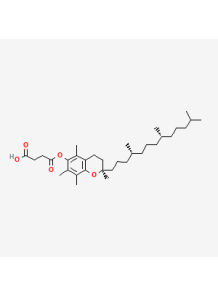
α‑Tocopheryl succinate 1210IU (α‑TOS, vitamin E succinate) – a vitamin E ester supplied as a white crystalline powder, used in supplements and researched as a mitochondrial‑targeted antioxidant; typical supplemental use ~200–400 mg/day.
α-tocopheryl succinate 1210IU (α-TOS, vitamin E succinate) assay 96.0–102.0% is a d‑α‑tocopheryl ester of succinic acid – a vitamin E derivative used in nutraceuticals and extensively studied as a mitochondrial‑targeted antioxidant in preclinical oncology models. It is a white or almost white crystalline powder, practically insoluble in water, soluble in acetone and ethanol, and very soluble in methylene chloride; suitable for use as a vitamin E source in dietary supplement formulations.
| Benefit | Typical study dose* | Key human findings | High-quality sources |
|---|---|---|---|
| Vitamin E support & antioxidant status | ~200–400 mg/day vitamin E succinate (or equivalent) for weeks–months | Human experience comes mainly from vitamin E ester supplements (e.g., succinate/TPGS) and mixed vitamin E preparations, showing maintenance of serum vitamin E and antioxidant markers; outcome benefits are not established. | PubMed |
| Adjunct anti‑cancer research (preclinical) | Cell models: 10–50 µM; animal models: mg/kg dosing (not directly translatable to supplements) | α‑Tocopheryl succinate selectively triggers apoptosis in many tumour cell lines while sparing normal cells in vitro and shows tumour‑growth inhibition in several rodent models; there are no approved cancer indications and human outcome data are very limited. | PMC |
| Drug‑delivery & bioavailability (TPGS analog) | Typically 100–300 mg/day TPGS in oral products, or lower amounts as an excipient | A water‑soluble PEGylated derivative (TPGS) of vitamin E succinate is widely used as a pharmaceutical excipient to improve solubility and absorption of poorly soluble drugs; experience supports good tolerability within usual supplemental ranges. | PubMed |
*Doses shown are typical in studies or commercial supplement practice; products and formulations differ. α‑TOS is not an approved medicine and should not be presented as a stand‑alone cancer therapy.
| Test Name | Specification |
|---|---|
| Characters | White or almost white crystalline powder; practically insoluble in water; soluble in acetone and ethanol; very soluble in methylene chloride. |
| Identification (IR) | Infrared absorption spectrum conforms to that obtained with the d-α-tocopheryl acid succinate reference standard. |
| Specific optical rotation | ≥ +24° |
| Absorbance at 284 nm | 35–38 |
| Absorbance at 254 nm | 6.0–8.0 |
| Acid value (mgKOH/g) | 101–108 |
| Loss on drying | ≤ 2.0% |
| Free tocopherol | ≤ 1.0% |
| Heavy metals | ≤ 10 ppm |
| Sulphated ash | ≤ 0.10% |
| Assay (α-tocopheryl succinate) | 96.0–102.0% |
No products
α‑Tocopheryl succinate 1210IU (α‑TOS, vitamin E succinate) – a vitamin E ester supplied as a white crystalline powder, used in supplements and researched as a mitochondrial‑targeted antioxidant; typical supplemental use ~200–400 mg/day.
α-tocopheryl succinate 1210IU (α-TOS, vitamin E succinate) assay 96.0–102.0% is a d‑α‑tocopheryl ester of succinic acid – a vitamin E derivative used in nutraceuticals and extensively studied as a mitochondrial‑targeted antioxidant in preclinical oncology models. It is a white or almost white crystalline powder, practically insoluble in water, soluble in acetone and ethanol, and very soluble in methylene chloride; suitable for use as a vitamin E source in dietary supplement formulations.
| Benefit | Typical study dose* | Key human findings | High-quality sources |
|---|---|---|---|
| Vitamin E support & antioxidant status | ~200–400 mg/day vitamin E succinate (or equivalent) for weeks–months | Human experience comes mainly from vitamin E ester supplements (e.g., succinate/TPGS) and mixed vitamin E preparations, showing maintenance of serum vitamin E and antioxidant markers; outcome benefits are not established. | PubMed |
| Adjunct anti‑cancer research (preclinical) | Cell models: 10–50 µM; animal models: mg/kg dosing (not directly translatable to supplements) | α‑Tocopheryl succinate selectively triggers apoptosis in many tumour cell lines while sparing normal cells in vitro and shows tumour‑growth inhibition in several rodent models; there are no approved cancer indications and human outcome data are very limited. | PMC |
| Drug‑delivery & bioavailability (TPGS analog) | Typically 100–300 mg/day TPGS in oral products, or lower amounts as an excipient | A water‑soluble PEGylated derivative (TPGS) of vitamin E succinate is widely used as a pharmaceutical excipient to improve solubility and absorption of poorly soluble drugs; experience supports good tolerability within usual supplemental ranges. | PubMed |
*Doses shown are typical in studies or commercial supplement practice; products and formulations differ. α‑TOS is not an approved medicine and should not be presented as a stand‑alone cancer therapy.
| Mechanism | - |
| Appearance | - |
| Longevity | - |
| Strength | - |
| Storage | - |
| Shelf Life | - |
| Allergen(s) | - |
| Dosage (Range) | - |
| Recommended Dosage | - |
| Dosage (Per Day) | - |
| Recommended Dosage (Per Day) | - |
| Mix Method | - |
| Heat Resistance | - |
| Stable in pH range | - |
| Solubility | - |
| Product Types | - |
| INCI | - |