


“Avobenzone-containing sunscreen protected photosensitized human skin against UVA-induced phototoxic erythema.”
Avobenzone or Butyl methoxydibenzoylmethane is an organic sunscreen or chemical sunscreen that can protect against UVA in the wave frequency range from 320-390nm, which completely covers UVA I / UVA II.
Avobenzone or Butyl methoxydibenzoylmethane is an organic sunscreen or chemical sunscreen. That can protect against UVA in the wave frequency range from 320-390nm, which completely covers UVA I / UVA II.
The use of Avobenzone in the formula must not contain Zinc Oxide, Titanium Dioxide and Octyl methoxycinnamate. This is because it will cause Avobenzone to deteriorate quickly.
We also offer this type of UV Protection agent in water-based system: SynMax™ (UVA+UVB, Water Dispersion) which contains BEMT, DHHB, Ethylhexyl Triazone, Avobenzone in patented system which protects full range of UVA-UVB and highly stable when exposes to UV
Additional tips on using Avobenzone in any sunscreen formula:
1. There should be 0.1% Disodium EDTA in the water to help protect Avobenzone from metal ions.
2. Do not contain Alumina or sunscreen containing Alumina (such as some types of Titanium Dioxide).
3. Warm using heat at 80-85 degrees until completely dissolved in the oil. (Please choose any solvent from the information below) for maximum efficiency.
Sun protection table of each type of sunscreen according to wavelength (UV wavelength)
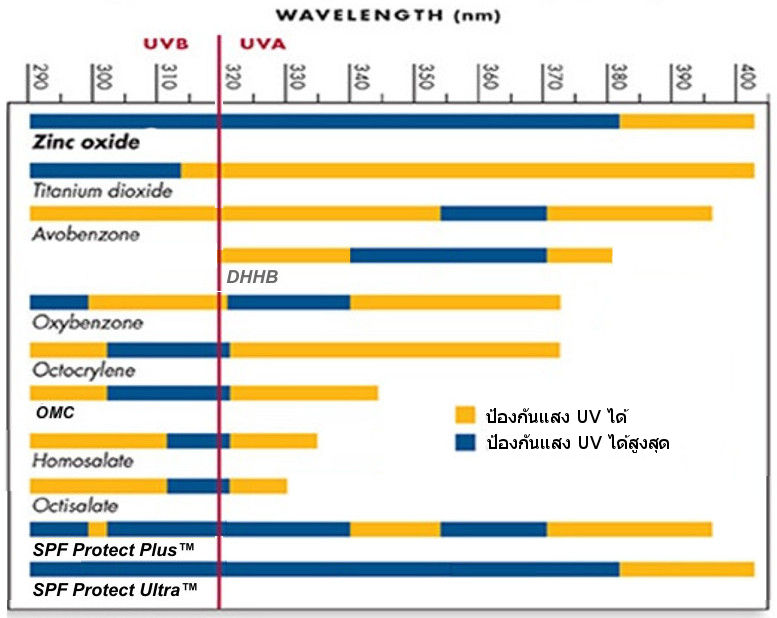
The importance of protecting against both UVA and UVB: UVA causes wrinkles. The aging process of the skin occurs (accelerates the age of the skin). UVB causes the skin to burn. Therefore it is necessary to protect both UVA and UVB at the same time.
Dissolving Avobenzone in various sunscreens and LipidSoft:
This is because Avobenzone is in the form of a powder. These need to be dissolved in solvents.
Solubility up to 26% in LipidSoft™ Solve (Avobenzone 26% in LipidSoft Solve 74%)
Soluble up to 24% in Octocrylene ( Avobenzone 24% in Octocrylene 76%).
Soluble up to 21% in Octisalate ( Avobenzone 21% in Octisalate 79%).
Soluble up to 25% in OMC ( Avobenzone 25% in OMC 75%).
Soluble up to 19% in Homosalate ( Avobenzone 19% in Homosalate 81%).
Solubility up to 14% in LipidSoft™ C1215 ( Avobenzone 14% in LipidSoft 86%)
Calculating PA value or UVA protection efficiency
Avobenzone 3% or more = PA+++ (protects against UVA more than 8 times)
Avobenzone 2% = PA++ (protects against UVA 4 times more)
Avobenzone 1% = PA+ (protects against UVA more than 2 times)
FDA rules for using Avobenzone in any type of cosmetics
Thailand: not more than 5%
Europe: not more than 5%
USA: no more than 3%
Japan: no more than 10%
(In the case of products for export Must follow FDA regulations of the destination country)
Usage rate: 1-5% (Please see the mixing ratio between other types of chemical sunscreen and SPF/PA values)
Appearance: Light yellow powder soluble in oil cannot dissolve in water
Mixing: Mix in oil or emollient such as various types of LipidSoft group (heat can be used to accelerate dissolution). Should be used together with Octocrylene. There should not be Physical Sunscreen (Titanium Dioxide, Zinc Oxide) included in the formula. This is because Avobenzone will quickly degrade in quality when exposed to UV light.
INCI: Butyl methoxydibenzoylmethane
| Test Name | Specification |
|---|---|
| Appearance | White to pale yellow powder |
| Odour | Faint characteristic |
| Identification By UV | Comparable to standard |
| Identification By IR | Comparable to standard |
| Melting Point (degree Celsius) | Between 81 degree Celsius and 86 degree Celsius |
| % Loss on drying | Not more than 0.5% |
| UV Specific Extinction E^1%, 1 cm (in Ethanol) | Between 1100 to 1180 at 357 +/- 2 mm |
| Chromatographic purity - Individual impurity | Not more than 3.0% |
| Chromatographic purity - Sum of all impurities | Not more than 4.5% |
| Assay (Dried basis) | Between 95% to 105% |
| scienceLab Service | Price |
|---|---|
open_in_newSun Protection Factor (SPF) Measurement by UV- Vis SpectrophotometryMeasurement of SPF/PA value on a finished product | ฿ 1,800.00 |
No products
Avobenzone or Butyl methoxydibenzoylmethane is an organic sunscreen or chemical sunscreen that can protect against UVA in the wave frequency range from 320-390nm, which completely covers UVA I / UVA II.
Avobenzone or Butyl methoxydibenzoylmethane is an organic sunscreen or chemical sunscreen. That can protect against UVA in the wave frequency range from 320-390nm, which completely covers UVA I / UVA II.
The use of Avobenzone in the formula must not contain Zinc Oxide, Titanium Dioxide and Octyl methoxycinnamate. This is because it will cause Avobenzone to deteriorate quickly.
We also offer this type of UV Protection agent in water-based system: SynMax™ (UVA+UVB, Water Dispersion) which contains BEMT, DHHB, Ethylhexyl Triazone, Avobenzone in patented system which protects full range of UVA-UVB and highly stable when exposes to UV
Additional tips on using Avobenzone in any sunscreen formula:
1. There should be 0.1% Disodium EDTA in the water to help protect Avobenzone from metal ions.
2. Do not contain Alumina or sunscreen containing Alumina (such as some types of Titanium Dioxide).
3. Warm using heat at 80-85 degrees until completely dissolved in the oil. (Please choose any solvent from the information below) for maximum efficiency.
Sun protection table of each type of sunscreen according to wavelength (UV wavelength)
The importance of protecting against both UVA and UVB: UVA causes wrinkles. The aging process of the skin occurs (accelerates the age of the skin). UVB causes the skin to burn. Therefore it is necessary to protect both UVA and UVB at the same time.
Dissolving Avobenzone in various sunscreens and LipidSoft:
This is because Avobenzone is in the form of a powder. These need to be dissolved in solvents.
Solubility up to 26% in LipidSoft™ Solve (Avobenzone 26% in LipidSoft Solve 74%)
Soluble up to 24% in Octocrylene ( Avobenzone 24% in Octocrylene 76%).
Soluble up to 21% in Octisalate ( Avobenzone 21% in Octisalate 79%).
Soluble up to 25% in OMC ( Avobenzone 25% in OMC 75%).
Soluble up to 19% in Homosalate ( Avobenzone 19% in Homosalate 81%).
Solubility up to 14% in LipidSoft™ C1215 ( Avobenzone 14% in LipidSoft 86%)
Calculating PA value or UVA protection efficiency
Avobenzone 3% or more = PA+++ (protects against UVA more than 8 times)
Avobenzone 2% = PA++ (protects against UVA 4 times more)
Avobenzone 1% = PA+ (protects against UVA more than 2 times)
FDA rules for using Avobenzone in any type of cosmetics
Thailand: not more than 5%
Europe: not more than 5%
USA: no more than 3%
Japan: no more than 10%
(In the case of products for export Must follow FDA regulations of the destination country)
Usage rate: 1-5% (Please see the mixing ratio between other types of chemical sunscreen and SPF/PA values)
Appearance: Light yellow powder soluble in oil cannot dissolve in water
Mixing: Mix in oil or emollient such as various types of LipidSoft group (heat can be used to accelerate dissolution). Should be used together with Octocrylene. There should not be Physical Sunscreen (Titanium Dioxide, Zinc Oxide) included in the formula. This is because Avobenzone will quickly degrade in quality when exposed to UV light.
INCI: Butyl methoxydibenzoylmethane
| Mechanism | - |
| Appearance | - |
| Longevity | - |
| Strength | - |
| Storage | - |
| Shelf Life | - |
| Allergen(s) | - |
| Dosage (Range) | - |
| Recommended Dosage | - |
| Dosage (Per Day) | - |
| Recommended Dosage (Per Day) | - |
| Mix Method | - |
| Heat Resistance | - |
| Stable in pH range | - |
| Solubility | - |
| Product Types | - |
| INCI | - |