


“Closest 12-HSA organogel-family evidence: 12-HSA structured acai oil into a stable cosmetic organogel with rheology/mechanical properties relevant to topical anti-aging vehicles.”
Organogel structurant for oil/silicone phases that builds thixotropy and improves pigment suspension and stability in anhydrous and emulsion systems.
Trihydroxystearin (Flakes) is a castor‑oil–derived glycerol triester of 12‑hydroxystearic acid (INCI: Trihydroxystearin) used as an oil‑phase rheology modifier and organogel structurant in cosmetics.
It builds a thixotropic (shear‑thinning) network in low‑ to moderate‑polarity liquids such as mineral oils, triglycerides/vegetable oils and silicone oils, improving pigment/filler suspension, leveling, and payoff—especially in sticks and anhydrous systems.
Performance is processing‑dependent: the network must be activated under shear in a controlled temperature window and mixed through cool‑down to prevent gel particles and “false body”.
Product Description: Trihydroxystearin is a crystalline fatty‑acid triester that self‑associates to form a 3‑D network in suitable oils. In practice it is used to (1) structure oils/silicones into stable organogels, (2) reduce settling in pigment dispersions by increasing low‑shear yield, and (3) support emulsion stability by reinforcing the oil phase rheology.
| Key point | Practical implication |
|---|---|
| Activation window | Build viscosity/thixotropy around 55–65°C under shear; below ~55°C the network may not fully develop. |
| Upper temperature limit | Above ~65°C (especially in more polar oils/solvents) may lead to soft gel particles on cool‑down; maintain mixing through cool‑down. |
| Cool‑down shear | Continue stirring until below ~45°C to avoid particle formation and “false body”. |
Typical specifications (example guidance): melting point 85–88°C; acid value ≤3 mgKOH/g; hydroxyl value ~154–165; iodine value ≤4; saponification value ~176–182.
Usage: Oil/silicone structuring (organogels), anti‑settling for pigment dispersions, sticks/balms, and oil‑phase rheology support in emulsions. Also used at low levels as a binder in pressed powders.
Mixing method:
- Add into the oil phase early (or at the start of anhydrous dispersion) and pre‑mix oils before adding powders/pigments.
- Heat to ~55–65°C and apply high shear for ≥20 min (often ~30 min) to fully activate thixotropy.
- Avoid processing below ~55°C (weak structuring) and avoid excessive heat above ~65°C where gel particles may appear on cooling (limit may be lower in more polar oils/solvents).
- Maintain stirring during cool‑down until below ~45°C; do not pack off hot without mixing to avoid “false body”.
- For stick/balm systems where wax‑like setting is desired, it can be melted above ~80–85°C (above melting point) and allowed to set under controlled cooling; validate texture and payoff in your base oil blend.
Usage rate: 0.2–0.8% (oil/silicone structuring, typical); 0.5–2% (pressed powders); higher levels may be used in sticks/balms depending on the system (screen up to ~10%).
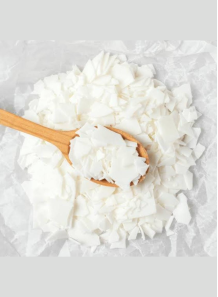
Product characteristics: White to light‑yellow flakes/powder; faint characteristic odor; melting point 85–88°C.
Solubility: Insoluble in water. Dispersible in nonpolar to moderately polar oils and silicone oils where it forms a thixotropic gel network; performance depends on oil polarity—screen your oil phase blend if using higher‑polarity esters/solvents.
Storage: Store dry at room temperature (15–25°C), tightly closed. Protect from heat and contamination; keep away from moisture pickup and airborne dust.
| Test Name | Specification |
|---|---|
| State (20°C) | White to pale yellow flaky solid |
| Melting Point | 85-88 ℃ |
| Color (100°C) | 0-250 APHA |
| Odor (20°C) | Slight characteristic odor |
| Acid Value | 0-2 mgKOH/g |
| Saponification Value | 175-185 mgKOH/g |
| Moisture | 0-0.5 % |
No products
Organogel structurant for oil/silicone phases that builds thixotropy and improves pigment suspension and stability in anhydrous and emulsion systems.
Trihydroxystearin (Flakes) is a castor‑oil–derived glycerol triester of 12‑hydroxystearic acid (INCI: Trihydroxystearin) used as an oil‑phase rheology modifier and organogel structurant in cosmetics.
It builds a thixotropic (shear‑thinning) network in low‑ to moderate‑polarity liquids such as mineral oils, triglycerides/vegetable oils and silicone oils, improving pigment/filler suspension, leveling, and payoff—especially in sticks and anhydrous systems.
Performance is processing‑dependent: the network must be activated under shear in a controlled temperature window and mixed through cool‑down to prevent gel particles and “false body”.
Product Description: Trihydroxystearin is a crystalline fatty‑acid triester that self‑associates to form a 3‑D network in suitable oils. In practice it is used to (1) structure oils/silicones into stable organogels, (2) reduce settling in pigment dispersions by increasing low‑shear yield, and (3) support emulsion stability by reinforcing the oil phase rheology.
| Key point | Practical implication |
|---|---|
| Activation window | Build viscosity/thixotropy around 55–65°C under shear; below ~55°C the network may not fully develop. |
| Upper temperature limit | Above ~65°C (especially in more polar oils/solvents) may lead to soft gel particles on cool‑down; maintain mixing through cool‑down. |
| Cool‑down shear | Continue stirring until below ~45°C to avoid particle formation and “false body”. |
Typical specifications (example guidance): melting point 85–88°C; acid value ≤3 mgKOH/g; hydroxyl value ~154–165; iodine value ≤4; saponification value ~176–182.
Usage: Oil/silicone structuring (organogels), anti‑settling for pigment dispersions, sticks/balms, and oil‑phase rheology support in emulsions. Also used at low levels as a binder in pressed powders.
Mixing method:
- Add into the oil phase early (or at the start of anhydrous dispersion) and pre‑mix oils before adding powders/pigments.
- Heat to ~55–65°C and apply high shear for ≥20 min (often ~30 min) to fully activate thixotropy.
- Avoid processing below ~55°C (weak structuring) and avoid excessive heat above ~65°C where gel particles may appear on cooling (limit may be lower in more polar oils/solvents).
- Maintain stirring during cool‑down until below ~45°C; do not pack off hot without mixing to avoid “false body”.
- For stick/balm systems where wax‑like setting is desired, it can be melted above ~80–85°C (above melting point) and allowed to set under controlled cooling; validate texture and payoff in your base oil blend.
Usage rate: 0.2–0.8% (oil/silicone structuring, typical); 0.5–2% (pressed powders); higher levels may be used in sticks/balms depending on the system (screen up to ~10%).
Product characteristics: White to light‑yellow flakes/powder; faint characteristic odor; melting point 85–88°C.
Solubility: Insoluble in water. Dispersible in nonpolar to moderately polar oils and silicone oils where it forms a thixotropic gel network; performance depends on oil polarity—screen your oil phase blend if using higher‑polarity esters/solvents.
Storage: Store dry at room temperature (15–25°C), tightly closed. Protect from heat and contamination; keep away from moisture pickup and airborne dust.
| Mechanism | - |
| Appearance | - |
| Longevity | - |
| Strength | - |
| Long-term storage | - |
| Shelf Life | - |
| Allergen(s) | - |
| Dosage (Range) | - |
| Recommended Dosage | - |
| Dosage (Per Day) | - |
| Recommended Dosage (Per Day) | - |
| Mix Method | - |
| Heat Resistance | - |
| Stable in pH range | - |
| Solubility | - |
| Product Types | - |
| INCI | - |