


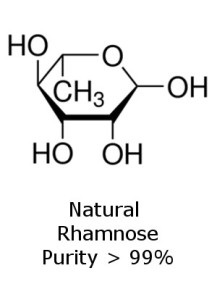
“Topical L-rhamnose showed anti-aging potential by improving papillary dermis/dermal-epidermal junction markers and stimulating procollagen I in reconstructed skin and an in vivo study.”
Ramnose is produced by natural bacterial incubation. to obtain a ramnose molecule which has many features such as protecting the skin from various types of bacteria Reduce inflammation of the skin. and reduce odor
Ramnose is produced by natural bacterial incubation. to obtain a ramnose molecule Which has many features as follows
1. Inhibition of the adhesion of pathogenic bacteria : From the experiment it was found that the use of Rhamnose in skin care products at a concentration of 3% could protect the skin from the formation of P.Acnes Bacteria (bacteria that cause acne) by 48% and Staphylococcus Aereus. (bacteria that cause atopic dermatitis) 28% and Staphylococcus Epidermidis (bacteria that cause bad smell) 24%
2. Modulation of the inflamatory response : from the test it was found that the use of Rhamnose in skin care products at a concentration of 0.7% can help reduce inflammation on the skin. by reducing the occurrence of Prostaglandin E2 (a molecule made by the skin when inflammation by 76% and reduced the production of Interleukin 8 (a chemokine produced by the skin). when inflammation caused by pathogens) 15%
3. Controlling odors in the auxiliary region : from an experiment it was found that applying Rhamnose 3% applied to the underarm / armpit area can reduce body odor by 25% lasting 6 hours and 26% lasting 9 hours and 11% lasting 25 hours.
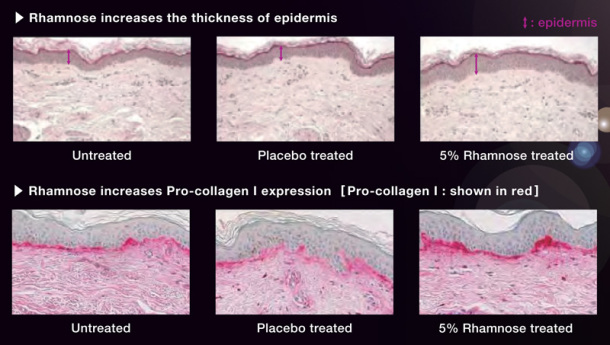
According to Shuu Emura's experimental data, ramnose can increase epidermis density and stimulate Pro-collagen I production in the skin.
Use: for mixing in all products
How to mix: Mix in water. The formula should have a pH in the range of 5-9.
Utilization rate: 1-5%
Product characteristics: White-light yellow powder, easy to get wet, please avoid moisture.
Solubility: can dissolve in water
INCI Name : Rhamnose (L-Rhamnose Monohydrate)
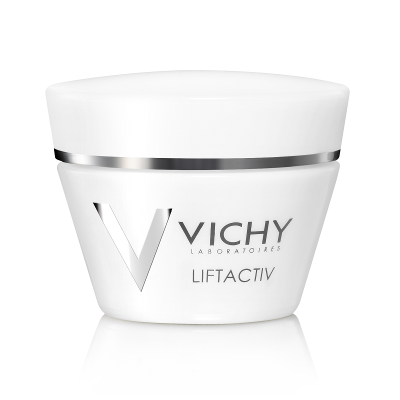
Rhamnose is used in a number of brands such as Vichy LIFTACTIV (using 5% Rhamnose), Shuu Emura, Bioderma : Sensibio H20.
| Test Name | Specification |
|---|---|
| Appearance | White or almost white crystalline , no odor,freely soluble in water, no observable impurities in normal eyesight |
| L-Rhamnose monohydrate Content | 98% Min |
| Loss on drying | 11% Max |
| Residue on ignition | 0.1% Max |
| Specific rotation | +7.7 to +8.9 |
| Identification | The RF of the principal spot of the sample solution corresponds to that of Standard solution |
| Chloride(Count in Cl-) | 0.005% Max |
| Appearance of solution | Solution clarification |
| Barium (mg/kg) | Any opalescence in the sample solution is not more intense than that in the standard solution |
| Acidity (/ml) | Consumption of 0.01mol/l sodium hydroxide is not more than 1.5 ml |
| Total Bacteria Count | 1000 Max |
No products
Ramnose is produced by natural bacterial incubation. to obtain a ramnose molecule which has many features such as protecting the skin from various types of bacteria Reduce inflammation of the skin. and reduce odor
Ramnose is produced by natural bacterial incubation. to obtain a ramnose molecule Which has many features as follows
1. Inhibition of the adhesion of pathogenic bacteria : From the experiment it was found that the use of Rhamnose in skin care products at a concentration of 3% could protect the skin from the formation of P.Acnes Bacteria (bacteria that cause acne) by 48% and Staphylococcus Aereus. (bacteria that cause atopic dermatitis) 28% and Staphylococcus Epidermidis (bacteria that cause bad smell) 24%
2. Modulation of the inflamatory response : from the test it was found that the use of Rhamnose in skin care products at a concentration of 0.7% can help reduce inflammation on the skin. by reducing the occurrence of Prostaglandin E2 (a molecule made by the skin when inflammation by 76% and reduced the production of Interleukin 8 (a chemokine produced by the skin). when inflammation caused by pathogens) 15%
3. Controlling odors in the auxiliary region : from an experiment it was found that applying Rhamnose 3% applied to the underarm / armpit area can reduce body odor by 25% lasting 6 hours and 26% lasting 9 hours and 11% lasting 25 hours.
According to Shuu Emura's experimental data, ramnose can increase epidermis density and stimulate Pro-collagen I production in the skin.
Use: for mixing in all products
How to mix: Mix in water. The formula should have a pH in the range of 5-9.
Utilization rate: 1-5%
Product characteristics: White-light yellow powder, easy to get wet, please avoid moisture.
Solubility: can dissolve in water
INCI Name : Rhamnose (L-Rhamnose Monohydrate)
Rhamnose is used in a number of brands such as Vichy LIFTACTIV (using 5% Rhamnose), Shuu Emura, Bioderma : Sensibio H20.
| Mechanism | - |
| Appearance | - |
| Longevity | - |
| Strength | - |
| Storage | - |
| Shelf Life | - |
| Allergen(s) | - |
| Dosage (Range) | - |
| Recommended Dosage | - |
| Dosage (Per Day) | - |
| Recommended Dosage (Per Day) | - |
| Mix Method | - |
| Heat Resistance | - |
| Stable in pH range | - |
| Solubility | - |
| Product Types | - |
| INCI | - |