


“Closest ingredient-family evidence: cholesterol-dominant ceramide/cholesterol/fatty-acid topical lipids accelerated barrier recovery in chronologically aged human skin after barrier disruption.”
deep long-lasting moisturizing, speed barrier repair, counter skin aging
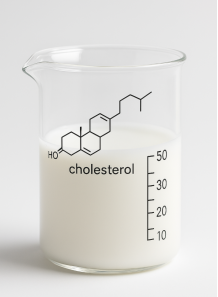
water dispersible cholesterol, highly concentrated at minimum of 11% Cholesterol
water dispersible cholesterol, highly concentrated at minimum of 11% Cholesterol
| Skin benefit | Take-home | Representative evidence* |
|---|---|---|
| 1. Speeds barrier repair & lowers TEWL | Cholesterol is one-third of the skin’s “mortar” (with ceramides + free fatty acids). Re-supplying it in an optimal 1:1:1 or cholesterol-dominant 2:4:2 molar ratio cuts the time required for a damaged barrier to reseal by 30–50%. | Ex-vivo human skin, aged volunteers: a 2:4:2 (cholesterol-rich) cream restored barrier integrity within 6 h, vs. 24 h for vehicle (PubMed 9308554). |
| 2. Deep, long-lasting moisturisation | By filling intercellular spaces it reduces water flux and raises stratum-corneum hydration; clinical users report ~40% hydration gain in 24 h. | Post-procedure study: “triple-lipid” 4% cholesterol formula ↑ corneometer hydration 39% in one day and maintained it 8 weeks (JDD case series). |
| 3. Counter-aging: restores lipid balance, smoothness, radiance | Natural epidermal cholesterol falls ≥25% after age 40. Topical 4% cholesterol (with 2% ceramide + 2% FFA) refills the deficit, thickens the viable epidermis, improves laxity and pores. | 8-week open study (n=55): significant gains in fullness, luminosity, and texture using the 2:4:2 cream twice daily (L’Oréal white paper; PubMed 39231086). |
| 4. Treats inflammatory dermatoses (eczema, psoriasis, contact dermatitis) | Physiologic-lipid moisturisers (≈ ceramide:cholesterol:FFA 3:1:1) reduced SCORAD/itch and allowed corticosteroid-free control. | Five-centre RCT (atopic dermatitis, n=121): barrier-repair emulsion cut disease severity and pruritus within 14 days (PMC5608132). |
| 5. Pathogenesis-based therapy for genetic barrier defects | Many ichthyoses, CHILD syndrome, porokeratosis and DSAP arise from blocked late-stage cholesterol synthesis. Co-applying missing cholesterol with a statin (to stop toxic precursors) normalises epidermis and scaling. | • ARCI case series: glycolic acid + 2% lovastatin/2% cholesterol ↓ severity 57% @ 3 mo (n=15) (PMC6248126). • Porokeratosis: topical 2% cholesterol/2% statin cleared lesions in 8 w (n=10). • CHILD syndrome: marked improvement by week 2 with 2% cholesterol/2% lovastatin lotion (Anais Dermatologia case report). |
| 6. Adjunct wound-healing & post-procedure care | Rapidly reseals laser- or microneedle-disrupted barrier, limits erythema and crusting. | Fractional laser patients: triple-lipid cream cut downtime and improved re-epithelialisation vs. bland ointment (JDD case series). |
*Most studies use cholesterol in physiologic-lipid blends (e.g., 2–4%) to match the natural SC ratio; pure-cholesterol ointments alone do not perform as well.
Used thoughtfully, cholesterol is more than an emollient—it is an active barrier-restoring lipid with clinically proven benefits across dry, aged and diseased skin.
Use: The main ingredient in moisturizer products for sensitive skin, dry skin, aging skin
How to mix: Can be directly disperse in water
Utilization rate: 0.1-5% (3% recommended)
Product characteristics: white liquid
Solubility: Can be dispersed in water
Storage: Valid for 24 months, please store in the room temp. *Do not freeze*
INCI: Water, Propylene Glycol, Cholesterol, Caprylic/Capric Triglyceride, Glyceryl Stearate, Phenoxyethanol, Chlorphenesin
| Test Name | Specification |
|---|---|
| Aspect | White or off-white milky |
| Odor | Characteristic |
| Cholesterol content | 11.5-12.5% |
| Heavy metals | NMT 20ppm (≤20ppm) |
| Total aerobic bacteria | NMT 500CFU/g (≤500CFU/g) |
| Yeast & Mold | NMT 100CFU/g (≤100CFU/g) |
No products
deep long-lasting moisturizing, speed barrier repair, counter skin aging
water dispersible cholesterol, highly concentrated at minimum of 11% Cholesterol
water dispersible cholesterol, highly concentrated at minimum of 11% Cholesterol
| Skin benefit | Take-home | Representative evidence* |
|---|---|---|
| 1. Speeds barrier repair & lowers TEWL | Cholesterol is one-third of the skin’s “mortar” (with ceramides + free fatty acids). Re-supplying it in an optimal 1:1:1 or cholesterol-dominant 2:4:2 molar ratio cuts the time required for a damaged barrier to reseal by 30–50%. | Ex-vivo human skin, aged volunteers: a 2:4:2 (cholesterol-rich) cream restored barrier integrity within 6 h, vs. 24 h for vehicle (PubMed 9308554). |
| 2. Deep, long-lasting moisturisation | By filling intercellular spaces it reduces water flux and raises stratum-corneum hydration; clinical users report ~40% hydration gain in 24 h. | Post-procedure study: “triple-lipid” 4% cholesterol formula ↑ corneometer hydration 39% in one day and maintained it 8 weeks (JDD case series). |
| 3. Counter-aging: restores lipid balance, smoothness, radiance | Natural epidermal cholesterol falls ≥25% after age 40. Topical 4% cholesterol (with 2% ceramide + 2% FFA) refills the deficit, thickens the viable epidermis, improves laxity and pores. | 8-week open study (n=55): significant gains in fullness, luminosity, and texture using the 2:4:2 cream twice daily (L’Oréal white paper; PubMed 39231086). |
| 4. Treats inflammatory dermatoses (eczema, psoriasis, contact dermatitis) | Physiologic-lipid moisturisers (≈ ceramide:cholesterol:FFA 3:1:1) reduced SCORAD/itch and allowed corticosteroid-free control. | Five-centre RCT (atopic dermatitis, n=121): barrier-repair emulsion cut disease severity and pruritus within 14 days (PMC5608132). |
| 5. Pathogenesis-based therapy for genetic barrier defects | Many ichthyoses, CHILD syndrome, porokeratosis and DSAP arise from blocked late-stage cholesterol synthesis. Co-applying missing cholesterol with a statin (to stop toxic precursors) normalises epidermis and scaling. | • ARCI case series: glycolic acid + 2% lovastatin/2% cholesterol ↓ severity 57% @ 3 mo (n=15) (PMC6248126). • Porokeratosis: topical 2% cholesterol/2% statin cleared lesions in 8 w (n=10). • CHILD syndrome: marked improvement by week 2 with 2% cholesterol/2% lovastatin lotion (Anais Dermatologia case report). |
| 6. Adjunct wound-healing & post-procedure care | Rapidly reseals laser- or microneedle-disrupted barrier, limits erythema and crusting. | Fractional laser patients: triple-lipid cream cut downtime and improved re-epithelialisation vs. bland ointment (JDD case series). |
*Most studies use cholesterol in physiologic-lipid blends (e.g., 2–4%) to match the natural SC ratio; pure-cholesterol ointments alone do not perform as well.
Used thoughtfully, cholesterol is more than an emollient—it is an active barrier-restoring lipid with clinically proven benefits across dry, aged and diseased skin.
Use: The main ingredient in moisturizer products for sensitive skin, dry skin, aging skin
How to mix: Can be directly disperse in water
Utilization rate: 0.1-5% (3% recommended)
Product characteristics: white liquid
Solubility: Can be dispersed in water
Storage: Valid for 24 months, please store in the room temp. *Do not freeze*
INCI: Water, Propylene Glycol, Cholesterol, Caprylic/Capric Triglyceride, Glyceryl Stearate, Phenoxyethanol, Chlorphenesin
| Mechanism | - |
| Appearance | - |
| Longevity | - |
| Strength | - |
| Storage | - |
| Shelf Life | - |
| Allergen(s) | - |
| Dosage (Range) | - |
| Recommended Dosage | - |
| Dosage (Per Day) | - |
| Recommended Dosage (Per Day) | - |
| Mix Method | - |
| Heat Resistance | - |
| Stable in pH range | - |
| Solubility | - |
| Product Types | - |
| INCI | - |